The Coastal Corrosion Audit: Why the Helderberg Climate is Killing Your Security Hardware
If you live or manage a property in the Helderberg—specifically within the 5km “Salt Belt” stretching from the Strand beachfront through to the foothills of Somerset West—you are familiar with the “Helderberg Tax.” It’s the invisible premium paid on everything from car paint to window frames. However, nowhere is this tax more expensive, or more dangerous, than in your security infrastructure.
At The Security Centre, we frequently receive call-outs for gate motors that “just stopped,” outdoor beams that trigger incessantly during a South Easter, or CCTV feeds that have turned into a milky fog. To the untrained eye, these seem like hardware faults. To a veteran technician, they are the predictable results of a brutal maritime microclimate.
Standard security hardware is often designed for the dry Highveld or European climates. When installed in the Helderberg without specific “ruggedisation,” it doesn’t just wear out—it disintegrates.
1. The Chemistry of Failure: Salt, Wind, and Electrolysis
The destruction begins with the South Easter. This wind doesn’t just bring cooler air; it carries a fine, pressurized mist of seawater. As this moisture settles on your security equipment, two lethal processes begin.
The Grinding Paste Effect
On mechanical components—specifically gate motor racks and pinions—the salt combines with ambient dust and the grease used to lubricate the gears. This creates a literal grinding paste. Every time your gate opens, this abrasive sludge wears down the metal or nylon teeth. Within 18 months, a motor that should have lasted a decade starts slipping or jumping its tracks.
The Silent Killer: Electrolysis
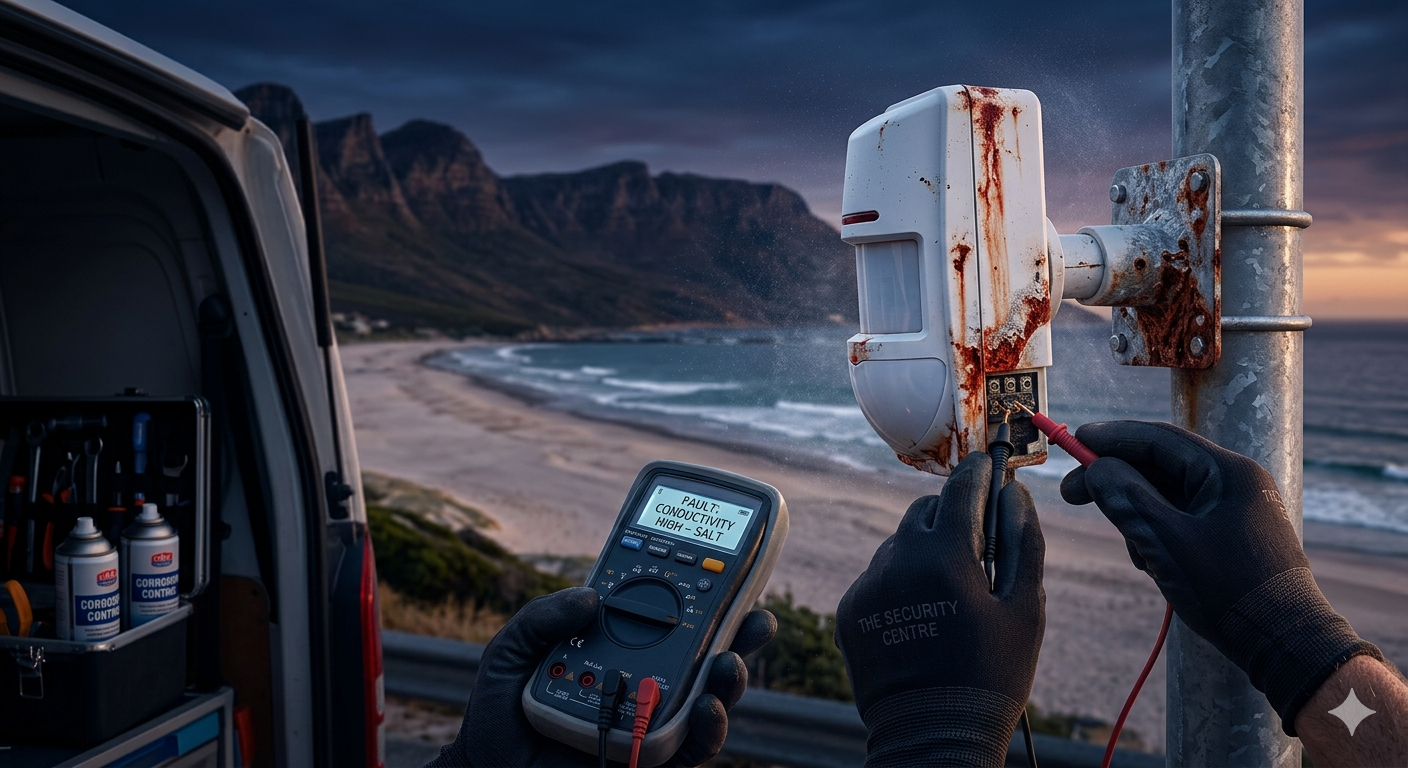
Inside your intercoms and alarm sensors, the salt air finds its way onto the Printed Circuit Boards (PCBs). Salt is highly conductive. When combined with the tiny amount of moisture in the air, it creates microscopic bridges between the copper tracks on the board. This leads to electrolysis—a chemical reaction that “eats” the copper until a connection is severed. This is why a sensor might look perfect on the outside but be completely dead on the inside.
2. The CCTV “Blind Spot”: When 4K Becomes 0K
We often see homeowners invest heavily in high-resolution 4K CCTV systems, only to find that two winters later, the image is useless. This is rarely a software issue; it is a material failure of the camera housing.
Standard cameras often use cheap plastic or low-grade aluminium housings with basic rubber gaskets. The Helderberg sun bakes these gaskets until they crack, allowing salt air to seep into the lens chamber. Once salt crystals form on the inside of the glass, they catch the light from the infrared (IR) LEDs at night, creating a “white-out” effect.
Furthermore, the salt air “etches” the outer glass or polycarbonate lens cover. This creates a permanent milky haze that no amount of cleaning can fix. For coastal installations, we mandate IP66 or IP67 rated marine-grade housings and, where possible, glass lenses rather than plastic, which offer significantly higher resistance to salt-etching.
3. The Outdoor Beam Nightmare: False Alarm Fatigue
There is nothing quite as frustrating as an alarm beam that triggers every time the wind picks up in Gordon’s Bay. This leads to “alarm fatigue,” where homeowners eventually turn off their outside protection—leaving them vulnerable.
Wind-Induced Motion
In the Helderberg, wind isn’t just a breeze; it’s a force. Cheap, single-technology PIR (Passive Infrared) beams detect heat signatures. When the South Easter blows, it moves vegetation and changes air temperature pockets rapidly, which these sensors interpret as a human moving.
Salt-Crusted Lenses
Just like CCTV cameras, the Fresnel lenses on outdoor beams (the “ribbed” plastic cover) attract salt. This salt diffracts the infrared light entering the sensor, making it either too sensitive (false alarms) or completely “blind” to an actual intruder.
The Specialist Solution: For coastal properties, we only recommend Dual-Technology beams. These require both an infrared trigger and a microwave Doppler shift to occur simultaneously before an alarm is raised. This effectively filters out the “noise” of the Helderberg wind.
4. The 5-Step Corrosion-Proofing Protocol
If you are installing new hardware, or want to save your current system, you must move beyond “out-of-the-box” installation. We use a specific protocol for every coastal site:
- Lanolin-Based Protection: We treat all exposed metal terminals and non-moving parts with a heavy-duty lanolin spray. Unlike standard lubricants, lanolin creates a natural, non-conductive barrier that salt cannot penetrate.
- Vapour-Phase Inhibitors (VPI): For gate motor housings and large alarm panels, we place VPI capsules inside the enclosure. These release a dry vapour that coats the electronics in a molecular layer of protection, stopping electrolysis before it starts.
- Silicone Gasket Reinforcement: We don’t trust factory seals. We apply a thin bead of marine-grade clear silicone to cable entry points and housing joins to ensure the salt air stays out.
- Dielectric Grease: All plug-and-socket connections (like those in your intercom or gate motor) are packed with dielectric grease to prevent pins from oxidizing and losing contact.
- Stainless Steel Fasteners: We replace standard zinc-plated screws with Grade 316 Stainless Steel fasteners. It seems like a small detail until you need to open a sensor for a battery change and find the screws have rusted solid into the plastic.
Technician’s Secret: The “Drip Loop”
Water and salt spray don’t just fall; they “run” down cables. Always ensure your technician leaves a “drip loop”—a small U-shaped sag in the cable before it enters a camera or motor. This forces gravity to drop the moisture off the bottom of the loop rather than funneling it directly into your expensive electronics.
5. Buy Once, Cry Once: Choosing Coastal-Ready Brands
When auditing your security, look for specifications, not just brands. In the Helderberg, you should prioritize:
- Powder-Coated or High-Density Polycarbonate: Avoid raw metal housings wherever possible.
- Sealed-Unit Energizers: For electric fences, choose energizers where the electronics are completely potted in resin.
- Stainless Steel Brackets: If a bracket is “galvanised,” it will likely show red rust within 12 months. Demand 316-grade stainless steel for all outdoor mounts.
At The Security Centre, we have curated a selection of hardware—from brands like Ajax, Paradox, and Centurion—specifically choosing the models we know can withstand the “Salt Belt” conditions.
Conclusion: Ruggedized Security for a Rugged Coastline
Security in Somerset West and the surrounding coast is not a “set and forget” project. The environment is actively trying to reclaim your hardware from the moment it is installed. By understanding the “Helderberg Tax” and implementing a rigorous corrosion-proofing strategy, you save yourself thousands in replacement costs and, more importantly, ensure your system actually works when you need it most.
Don’t wait for the salt to win. If your gate is sounding sluggish or your cameras are looking cloudy, contact The Security Centre for a comprehensive Coastal Corrosion Audit. We don’t just install security; we build it to survive the Helderberg.