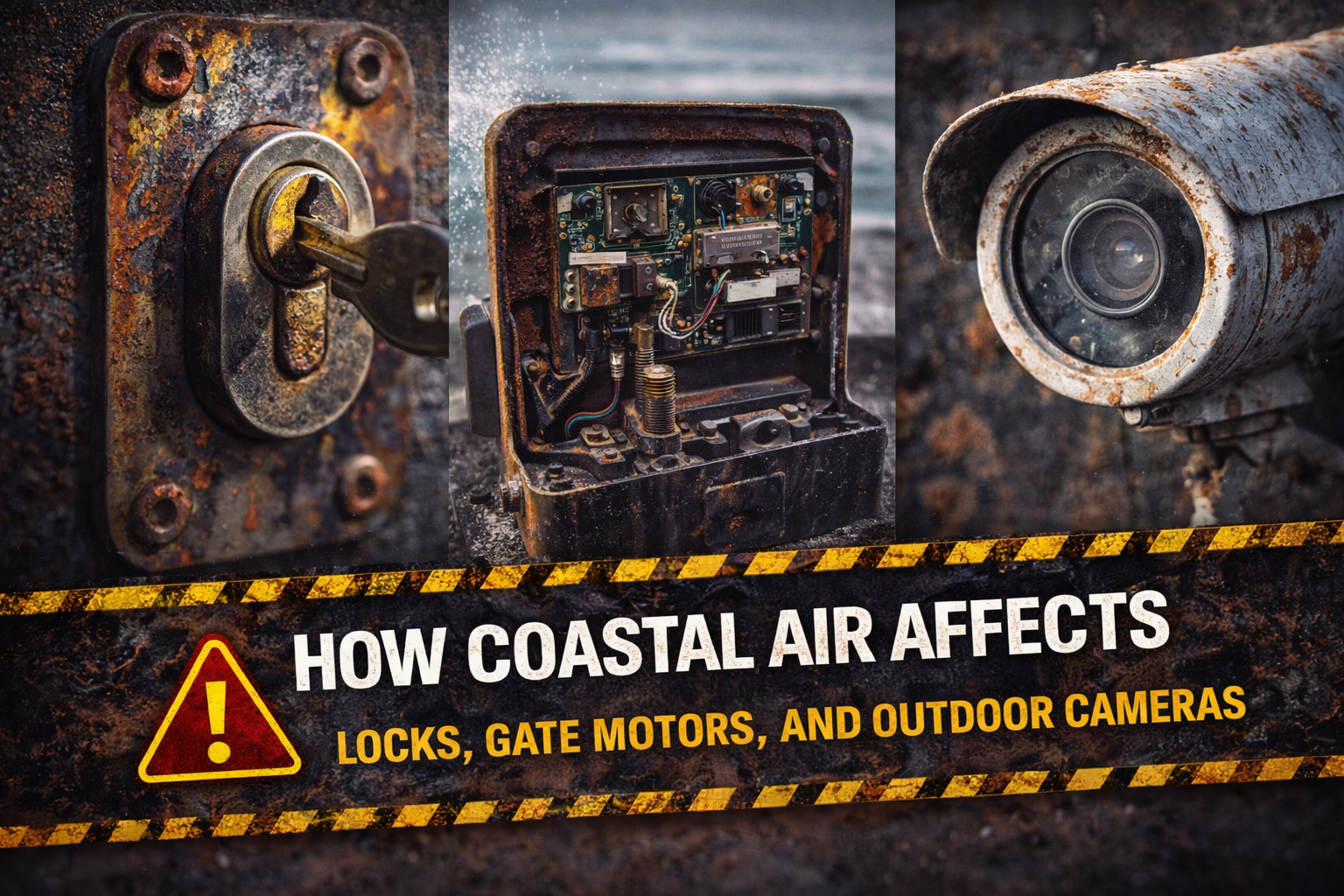
How Coastal Air Affects Locks, Gate Motors, and Outdoor Cameras
Coastal living is a win for lifestyle — but it’s tough on security hardware. Salt-laden air, humidity, and wind don’t need storms to cause damage. They work slowly, constantly, and invisibly, shortening the lifespan of locks, gate motors, and outdoor cameras across the Helderberg.
Quick context upfront: The Security Centre operates as a security equipment wholesaler and technical product authority, not an installer or repair service. From the supply side, we see how coastal exposure changes failure patterns. Installation, maintenance, and repairs are handled by qualified installers or technicians. This article explains why coastal systems age differently — and what to expect.
Coastal air is invisible, but aggressive
You don’t need waves crashing over your wall to have “coastal conditions”. In Somerset West, Strand, Gordon’s Bay, and nearby areas, salt particles travel inland on the wind. They settle on metal surfaces, draw moisture from the air, and accelerate corrosion — even on equipment that looks sealed.
This isn’t dramatic damage. It’s gradual degradation.
What makes coastal air different
Three factors combine to cause trouble:
- Salt particles that cling to metal and electronics
- High humidity that keeps surfaces slightly damp
- Wind exposure that pushes salt into crevices and housings
Together, they speed up oxidation and wear — especially on moving parts and exposed connectors.
How coastal air affects locks and cylinders
Locks fail quietly near the coast.
What we commonly see
- Cylinders becoming stiff or gritty
- Internal corrosion that isn’t visible externally
- Keys wearing faster than expected
- Sudden failures after “working fine yesterday”
Why this happens
Salt and moisture creep inside the lock body. Lubricants break down, springs weaken, and tolerances tighten until movement becomes unreliable.
Reality check
A lock that works smoothly inland may need far more frequent attention near the coast.
How coastal air affects gate motors and automation
Gate motors are hit from two sides: mechanical movement and electronics.
Mechanical impact
- Bearings corrode and become noisy
- Shafts and gears wear faster
- Increased resistance puts strain on motors
Electronic impact
- Control boards suffer from corrosion on contacts
- Enclosures trap humid air
- Sensors and limit switches misbehave
Add load shedding to the mix, and failures become more frequent — not because the motor is “bad”, but because the environment is relentless.
How coastal air affects outdoor cameras
Outdoor cameras rarely fail outright. They age poorly.
Common symptoms
- Corrosion on housings and mounts
- Seal degradation allowing moisture ingress
- Fogging inside lenses
- Gradual image quality decline
By the time footage looks bad, damage has often been happening for months.
Why coastal damage is often misdiagnosed
A lot of coastal failures get blamed on:
- “Cheap equipment”
- “Bad installation”
- “Faulty batches”
In reality, many systems are simply operating outside the conditions they were designed for. Inland expectations don’t translate cleanly to coastal environments.
Material and design choices that matter more near the coast
Near the coast, small specification choices have a big impact:
- Corrosion-resistant finishes and fasteners
- Better enclosure ratings
- Thoughtful ventilation vs sealing balance
- Reduced reliance on exposed moving parts
This isn’t about premium for the sake of it — it’s about survivability.
Maintenance expectations in coastal areas
Coastal systems need a different mindset.
What changes
- Shorter service intervals
- More proactive replacement of consumables
- Earlier attention to “minor” stiffness or noise
Waiting for outright failure near the coast usually costs more than planned upkeep.
Early warning signs end users should watch for
You don’t need tools to spot trouble early:
- Locks becoming stiff or inconsistent
- Gate motors sounding louder or slower
- Cameras fogging, discolouring, or losing clarity
- Rust marks around screws or mounts
- Increased false alarms or erratic behaviour
These are environmental signals, not random faults.
Supplier vs installer responsibilities (why this matters)
Clear roles help systems last longer:
- Suppliers advise on equipment suitability and expected lifecycle in coastal conditions
- Installers/technicians handle correct installation and maintenance
- End users adjust expectations and report changes early
Blaming hardware without considering environment just delays fixes.
Bottom line
Coastal air doesn’t break security equipment overnight. It wears it down steadily. Locks stiffen, motors strain, cameras lose clarity — all faster than inland equivalents.
In the Helderberg, the best-performing systems aren’t the most complex. They’re the ones specified with environmental reality in mind, maintained proactively, and judged by how they age — not how they look on day one.
Plan for the coast, and your security will last longer.