Security Risks Unique to Somerset West & the Helderberg
Security isn’t one-size-fits-all. What works in dense city suburbs often underperforms in the Helderberg, where geography, lifestyle, and infrastructure create predictable, localised risks. Understanding those risks is how you design systems that hold up in real life — not just on paper.
Quick context upfront: The Security Centre operates as a security equipment wholesaler and technical product authority, not an installer or response provider. We see patterns from the supply side. Design, installation, and response are handled by qualified professionals. This article explains what makes Somerset West and the wider Helderberg different — and why that matters.
Why location matters in security
Crime trends alone don’t tell the full story. Environment, layout, and daily behaviour shape vulnerabilities. In the Helderberg, those factors include coastal weather, semi-rural edges, estate living, mixed-use zones, and persistent power instability. Systems that ignore these realities tend to fail quietly.
Coastal and semi-rural geography risks
Somerset West sits at the edge of town and country. That mix brings space — and space brings risk.
What this creates
- Larger properties with long perimeters
- Fencing that’s hard to monitor end-to-end
- Vegetation and elevation that block sightlines
Why it matters
- Perimeter breaches go unseen
- Cameras cover driveways but miss boundaries
- Alarms trigger late, not early
Security here needs layering: perimeter awareness, not just internal detection.
Load shedding and infrastructure stress
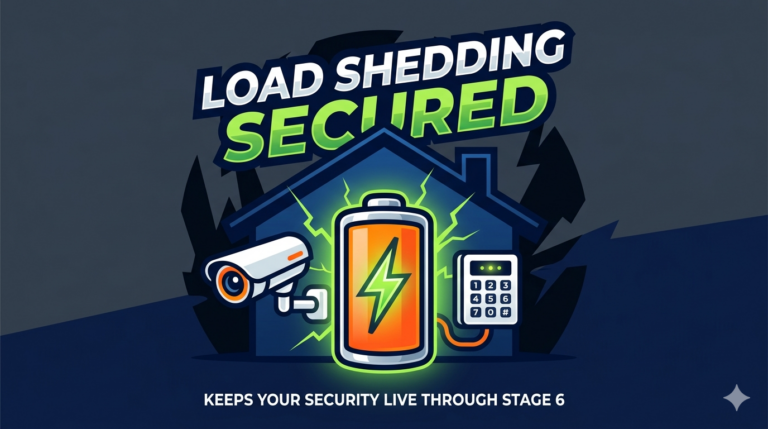
Load shedding hits the Helderberg like everywhere else — but its effects are amplified in spread-out areas.
Common consequences
- Batteries cycling daily and degrading faster
- Internet-dependent systems dropping during outages
- Equipment that works on mains but fails under stress
The mistake
Assuming backup power is a nice-to-have. Locally, it’s core design, not an add-on.
Estate living: protection with blind spots
Estates feel safer — and often are — but they introduce shared-infrastructure risks.
Typical oversights
- Overreliance on estate perimeter security
- Weak internal detection
- Shared access systems with uneven admin
Reality check
If an incident gets past the perimeter, internal systems matter more than ever. Estates need defence in depth, not confidence alone.
Free-standing homes: space and exposure
Outside estates, properties are larger and more varied.
Common vulnerabilities
- Multiple access points (garages, outbuildings, side gates)
- Long driveways with poor night visibility
- Secondary doors used daily and secured casually
Designs that focus only on the front door miss how Helderberg homes are actually used.
Business and light-industrial risk patterns
The Helderberg has a high density of small offices, medical practices, workshops, and mixed-use spaces.
What we see
- After-hours vulnerability
- Shared premises with unclear responsibility
- Access control that’s functional but unmanaged
For SMEs, access discipline (who, when, why) matters as much as alarms and cameras.
Lifestyle-driven risks
Local lifestyle choices shape exposure.
Helderberg specifics
- Outdoor living areas and large glass expanses
- Garages used as primary entrances
- Daytime vacancy due to commuting
Systems designed for “night-time break-ins only” miss daytime opportunity windows.
Technology assumptions that don’t hold locally
Some assumptions break down here:
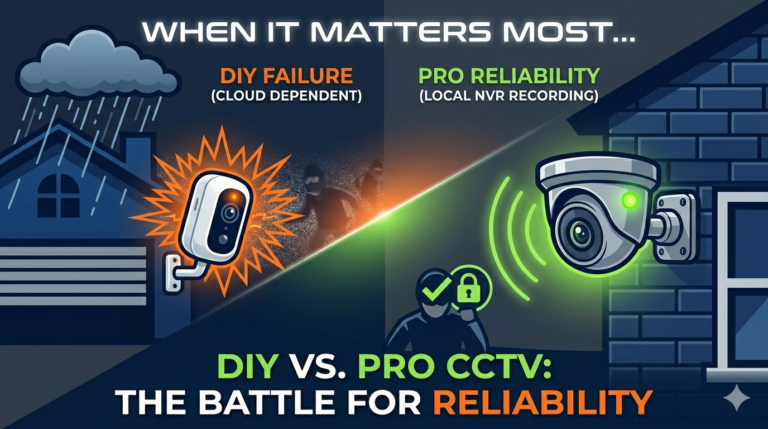
- “Internet-only is fine” → not during outages
- “Wireless means outage-proof” → batteries still fail
- “High-resolution equals security” → placement and retention matter more
Local conditions reward conservative, resilient design over feature chasing.
Common security oversights we see in the area
These aren’t rare — they’re patterns:
- Under-maintained batteries and power supplies
- Cameras aimed for coverage, not evidence
- Access control without audit discipline
- Systems never tested during load shedding
- False alarms ignored until response quality drops
None are dramatic. All are costly over time.
How local understanding improves system design
When you plan with Helderberg realities in mind:
- Power resilience becomes central
- Perimeter awareness is prioritised
- Internal detection complements estates and fencing
- Storage and retention are sized realistically
- Systems are tested under outage conditions
The result is calmer security — fewer surprises, better outcomes.
Role clarity matters (and prevents gaps)
Good outcomes depend on clear roles:
- Suppliers advise on suitability, capability, and lifecycle
- Installers design, commission, and test
- Users understand limits and maintain discipline
When roles blur, accountability disappears — and systems drift.
Bottom line
Somerset West and the Helderberg don’t have “unique crime” — they have unique conditions. Geography, lifestyle, and infrastructure shape risk in predictable ways. Security that ignores those factors underperforms. Security that plans for them lasts.
Informed, locally grounded planning beats reactive upgrades every time.