
Wired vs Wireless Alarm Systems in Load-Shedding Conditions
Load shedding has changed how security systems behave in the real world. Alarm systems that performed perfectly a few years ago are now being pushed far harder, far more often. The result? Batteries failing sooner than expected, communication gaps, and systems that look good on paper but struggle during extended outages.
Before getting into the comparison, a quick clarification. The Security Centre in Somerset West is a security equipment wholesaler and technical product authority, not an installer or monitoring company. We supply professional alarm equipment and advise on capability and suitability, while installation and commissioning are handled by qualified installers. This article is educational and based on how different alarm architectures respond to repeated power interruptions.
Why load shedding changes the alarm conversation
Alarm systems were originally designed around the assumption of stable mains power with occasional short outages. In South Africa, the reality is very different. Power interruptions are frequent, sometimes extended, and often unpredictable.
This means:
- Batteries cycle far more often
- Backup runtimes matter more than marketing specs
- Communication paths are stressed
- Poor system design shows up quickly
Under these conditions, the choice between wired and wireless alarms isn’t about which is “better” — it’s about how each behaves under strain.
What “wired” and “wireless” actually mean
These terms are often oversimplified.
- Wired alarm systems use physical cabling for sensors (PIRs, door contacts, beams) connected back to a central control panel.
- Wireless alarm systems use battery-powered sensors that communicate with the panel via radio signal.
- Hybrid systems combine both, using wired sensors where practical and wireless devices where flexibility is needed.
In all cases, the control panel is the heart of the system and still relies on power and communication paths to function properly.
Wired alarm systems under load shedding
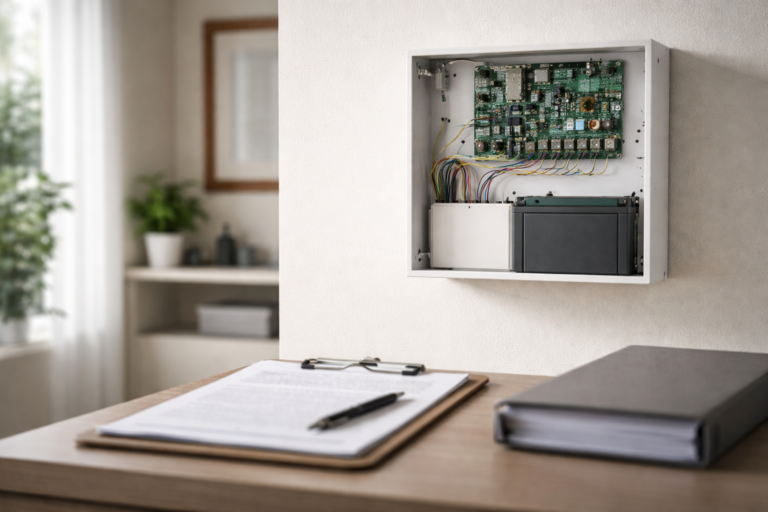
Wired systems draw their power centrally from the alarm panel.
Strengths
- Sensors do not rely on individual batteries
- Consistent sensor performance
- No radio signal dependency between sensors and panel
Limitations under load shedding
- The entire system depends on the panel battery
- If the panel battery is undersized or degraded, everything suffers
- Repeated outages shorten battery lifespan faster than expected
In practice, wired systems can be extremely reliable if the panel battery is correctly sized and maintained. Where they struggle is when backup power was designed for occasional outages, not daily cycling.
Wireless alarm systems under load shedding
Wireless systems distribute power across the system.
Strengths
- Each sensor has its own battery
- No reliance on long cable runs
- Faster installation and easier expansion
Limitations under load shedding
- Every sensor battery is affected by outage frequency
- Battery replacement becomes an ongoing maintenance task
- Radio supervision must be monitored properly
A common misconception is that wireless systems are “immune” to load shedding. They aren’t. While they avoid some centralised failures, they introduce many small points of battery dependency that need to be managed.
Battery backup: expectations vs reality
This is where most systems fall down.
Panel batteries
- Rated runtimes are often optimistic
- Performance drops as batteries age
- Frequent discharge cycles accelerate degradation
Device batteries
- Wireless sensor batteries last years under normal conditions
- Load shedding shortens this lifespan significantly
- Missed low-battery warnings cause false confidence
Under current conditions, battery health is not a “set and forget” item. It’s an ongoing reality.
Communication during power outages
An alarm system is only useful if it can communicate events.
During outages:
- Some communication paths fail earlier than expected
- Internet-dependent paths may drop
- Cellular paths still rely on powered infrastructure
The key takeaway is redundancy and realism. No single communication method should be assumed to be outage-proof.
Common load-shedding mistakes we see
From a wholesale and technical-support perspective, these come up repeatedly:
- Undersized or ageing panel batteries
- No battery replacement schedule
- Assuming wireless equals outage-proof
- Ignoring low-battery or supervision warnings
- Never testing the system during an outage
- No allowance for longer future outages
These are planning and maintenance issues, not brand or technology failures.
Which is better in practice?
There’s no universal winner.
Wired systems suit:
- Permanent installations
- Environments where cabling is practical
- Users who maintain backup power properly
Wireless systems suit:
- Homes and businesses needing flexibility
- Sites where cabling is impractical
- Installations designed with battery management in mind
In many cases, hybrid systems offer the best balance — combining wired reliability with wireless flexibility.
What matters most is not whether a system is wired or wireless, but whether it was specified honestly for load-shedding conditions.
Choosing equipment with local reality in mind
Before any installation happens, it helps to understand what alarm equipment is available locally and what each system is realistically designed to handle. Browsing the range offered by Alarm System Distributors Somerset West provides useful context when comparing system types, backup expectations, and expansion options.
As a wholesaler, The Security Centre focuses on helping customers and installers align equipment capability with real-world conditions, not ideal scenarios.
Working with a professional installer
Installers play a critical role in:
- Battery sizing and selection
- System layout and redundancy
- Commissioning and testing
- Setting realistic expectations
Suppliers advise on what equipment can do. Installers ensure it’s set up to actually do it.
Final thoughts
Load shedding isn’t temporary, and alarm systems need to be chosen with that reality front and centre. Wired and wireless systems can both work well — or fail badly — depending on how they’re specified, powered, and maintained.
The safest approach is informed planning, realistic expectations, and regular testing. In the current environment, design and maintenance matter more than the label on the box.