How to Select the Right CCTV Camera: Practical Insights from the Wholesale Counter
Before getting into camera types, it’s worth setting expectations clearly. The Security Centre in Somerset West is a security equipment wholesaler and technical supplier, not an installer. We supply professional CCTV equipment to installers across the Helderberg and assist with product selection, compatibility checks, and system planning. Installation and configuration are always carried out by independent, qualified installers.
This guide is educational. It reflects the real questions we’re asked daily at the counter — usually before someone realises that choosing the wrong camera type or recorder can quietly undermine the entire system.
Why camera choice matters more than specs
A common mistake is starting with megapixels or price. In reality, camera type, placement, lighting conditions, and recorder integration determine whether footage is usable when it matters.
From a wholesale perspective, most system failures aren’t caused by faulty equipment — they’re caused by equipment being mismatched to the environment.
The three core CCTV camera types explained
Most residential and small-to-medium commercial CCTV systems rely on bullet, dome, or PTZ cameras. Each has a specific role, and none are universally “better”.
Bullet cameras – visibility and direction
Bullet cameras are cylindrical and usually mounted externally.
They’re best suited to:
- Driveways and vehicle entrances
- Boundary walls and perimeters
- Long, narrow viewing angles
Their main strength is visibility. People can see where they’re pointing, which makes them an effective deterrent. The downside is that they’re more obvious targets if mounted too low and less discreet indoors.
From what we see locally, bullet cameras are most effective when used deliberately for external deterrence, not as a default choice everywhere.
Dome cameras – discreet and professional
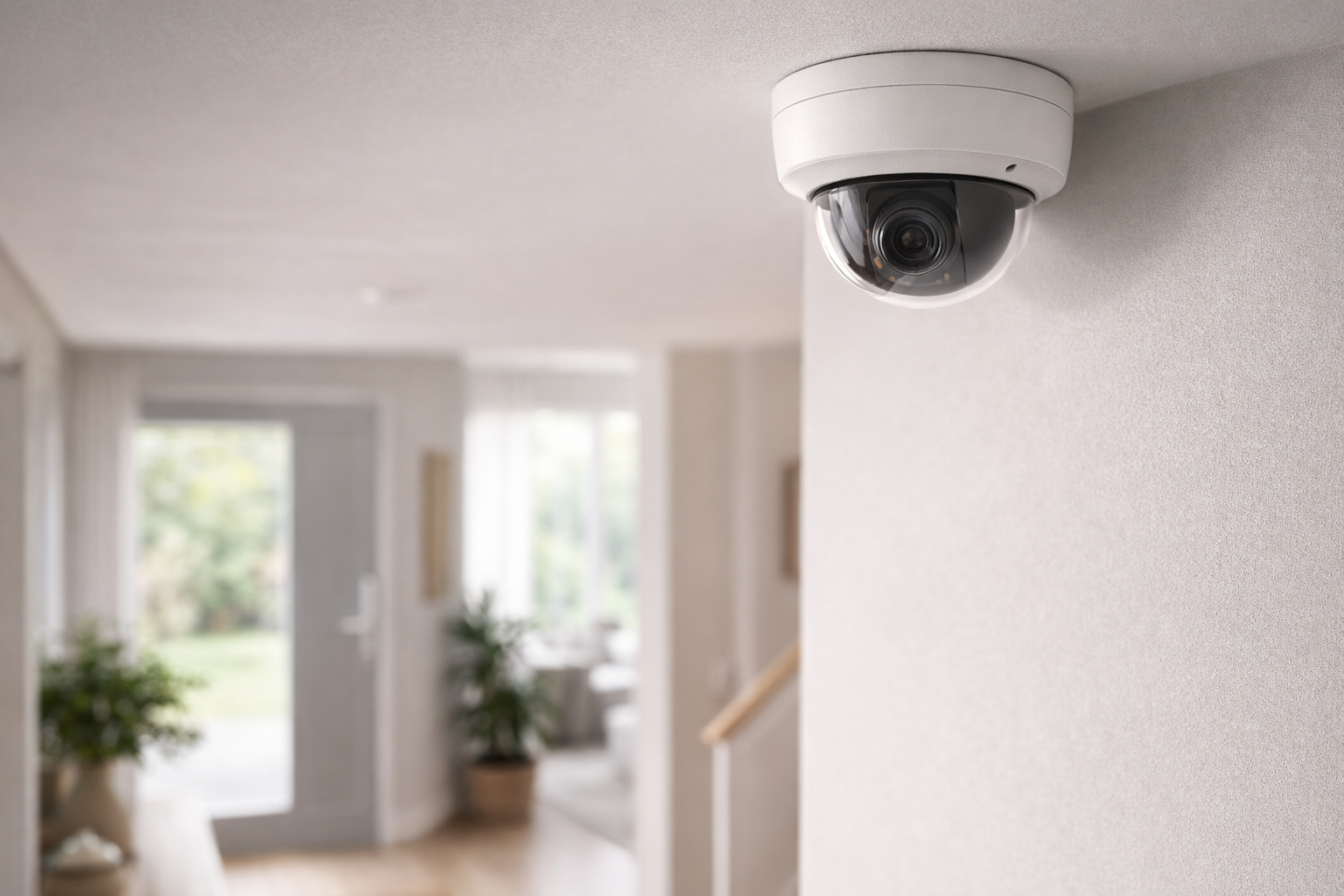
Dome cameras are enclosed in a compact housing and commonly used indoors or under roof overhangs.
They’re ideal for:
- Indoor living areas
- Offices and retail spaces
- Covered entrances and patios
Their direction of view is less obvious, they’re harder to tamper with, and they blend into professional environments more easily. The trade-off is that they’re not designed for long-distance coverage.
In Somerset West homes and businesses, dome cameras are often chosen where aesthetics and vandal resistance matter just as much as coverage.
PTZ cameras – powerful, but often misunderstood
PTZ (Pan-Tilt-Zoom) cameras can move and zoom, either automatically or under manual control.
They make sense in:
- Large open yards
- Warehouses
- Parking areas
- Sites with active monitoring
Where PTZ cameras fall short is when they’re expected to do everything. A PTZ camera can only look in one direction at a time. We regularly see systems where several fixed cameras would have provided better evidence coverage at lower cost.
PTZ cameras work best as part of a broader system, not as a shortcut.
Cameras and recorders: the part people overlook
Selecting cameras without understanding how they integrate with the recorder is one of the most common planning errors we see.
DVR vs NVR in plain terms
- DVRs are used with analogue or HD-over-coax cameras
- NVRs are used with IP cameras over network cable
Trying to mix incompatible cameras and recorders usually leads to last-minute changes, delays, or unnecessary replacements.
Channel limits and future-proofing
Every recorder has a fixed number of channels. Buying exactly what you need today often creates problems later.
From a wholesale planning point of view, it’s usually smarter to:
- Leave spare channels available
- Plan cable routes for expansion
- Confirm power and storage capacity upfront
This avoids redoing parts of the system when requirements change.
Storage planning that actually works
Higher resolution footage uses more storage, but that doesn’t automatically mean better outcomes.
Storage is affected by:
- Resolution and frame rate
- Number of cameras
- Compression format
- Recording mode (continuous vs motion)
The goal should be clear, usable footage retained for a realistic number of days, not maximum resolution with minimal retention.
Common CCTV planning mistakes we see in the Helderberg
Based on daily technical queries and system reviews, these issues come up repeatedly:
- Choosing camera resolution without planning storage
- Mixing incompatible cameras and recorders
- Using PTZ cameras where fixed cameras are more effective
- Ignoring night-time lighting conditions
- Poor camera angles creating blind spots
- Mounting cameras too high or too low
- No allowance for future expansion
- Underestimating load shedding impact
- Poor cable routing affecting image quality
- Expecting CCTV to fix bad placement decisions
Almost all of these can be avoided with proper planning before equipment is purchased.
Local considerations for Somerset West and the Helderberg
CCTV systems in this area face a few consistent challenges:
- Strong afternoon sunlight and glare
- Coastal wind and weather exposure
- Dust and moisture outdoors
- Load shedding and power dips
Homes typically prioritise perimeter and entrance coverage, while businesses require evidentiary footage and longer retention. Estates and body corporates often need consistent standards across multiple properties.
Working with a professional installer
While it’s useful to understand CCTV equipment, professional installation is essential for reliable results.
Installers ensure:
- Correct mounting height and lens selection
- Accurate aiming and focus
- Secure, tidy cabling
- Proper recorder configuration
- Long-term system stability
The best outcomes happen when installer expertise and correctly selected equipment work together.
Where to start when choosing equipment
If you’re still in the research or planning phase, it helps to first understand what equipment options exist and how they fit together. Browsing a curated range of professional CCTV systems and cameras suitable for residential and commercial use gives useful context before speaking to an installer.
You can view the current range of CCTV systems and cameras supplied by The Security Centre to better understand available camera types, recorders, and system configurations.
As a wholesaler, The Security Centre assists with equipment selection and compatibility advice, while continuing to support the independent installers who design and install CCTV systems across Somerset West and the wider Helderberg.